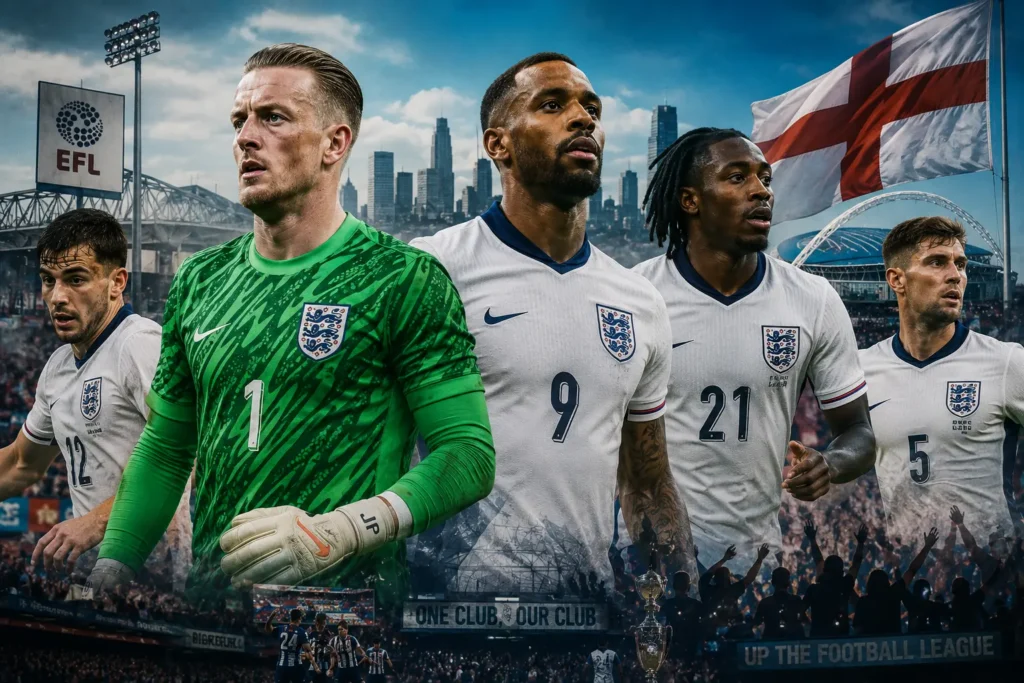
England head into the 2026 World Cup with arguably their most experienced squad in a generation. Behind the glamour of Jude Bellingham at Real Madrid and Harry Kane firing in the Bundesliga, there’s a quieter story worth telling. The EFL England World Cup connection runs deeper than most people realise. Thomas Tuchel’s 26-man group is living proof of it.
The EFL England World Cup Link Starts With the Academy System
The English Football League continues to be a significant breeding ground for international talent, with numerous current and former players set to feature in the 2026 World Cup. That’s not a new trend. But the scale of it this summer is striking.
The Elite Player Performance Plan was implemented by the Premier League in 2012 in partnership with the EFL and FA, following England’s failure to qualify for EURO 2008 and a disappointing 2010 FIFA World Cup campaign. The goal was clear: produce more and better homegrown players. Thirteen years on, that investment is showing up on the biggest stage of all.
Of Gareth Southgate’s 26 players at EURO 2024, 19 spent time in the academy system following the implementation of the EPPP. The development time for those 19 players totals 104 years, an average of more than five years per player. Many of those faces are now in Tuchel’s squad. The EFL fingerprints are all over them.
Jordan Pickford: Forged in the EFL England World Cup Pathway
Few stories better illustrate the EFL’s role than that of Jordan Pickford. Pickford began his career at Sunderland and played for their academy, reserve and senior teams. He had loan spells at Darlington, Alfreton Town, Burton Albion, Carlisle United, Bradford City and Preston North End before becoming England’s undisputed first choice.
Those loan stints weren’t just filler. They were where Pickford learned to handle pressure and make decisions under real match intensity. EFL football hardened him in ways training can’t. He’s now heading into his third World Cup as England’s undroppable starter.
Ivan Toney’s Journey and the EFL England World Cup Story
Perhaps the most compelling narrative in Tuchel’s squad belongs to Ivan Toney. His path is a textbook example of the pyramid working as it should.
It was at Peterborough United where Toney really hit the headlines, averaging more than a goal every two games during his two seasons, finding the net 49 times in 94 appearances in all competitions and being named the League One Player of the Year. That form persuaded Brentford to act. The rest followed fast.
His 31-goal haul in the 2020-21 season set a then-record for the most goals in a single Championship campaign, ultimately firing Brentford into the Premier League via the play-offs. From League One journeyman to Championship record-breaker to England World Cup striker. That’s the EFL system doing exactly what it was built to do.
Eberechi Eze’s Championship Roots
Eze is one of the most exciting players in Tuchel’s squad. But before winning the FA Cup with Crystal Palace and signing for Arsenal for £67.5 million, he ground out Championship seasons at Queens Park Rangers.
Eberechi Eze emerged at Queens Park Rangers, where two full Championship campaigns turned a technically gifted youth player into a senior footballer capable of carrying a team. That transformation took time. It happened across 46-game seasons in front of demanding crowds in England’s second division
His breakthrough came in the 2019-20 season, in which he scored 14 goals and was named the club’s Player of the Year. After three seasons with QPR, Eze moved to Crystal Palace in the summer of 2020 for his first taste of Premier League football. By the time Arsenal came calling, he was an England international with a World Cup spot secured.
The EFL England World Cup Case: Championship as a Tactical School
It’s not just about individual players making it. Championship football accelerates growth in ways academy football simply can’t. The Championship is one of the most varied tactical leagues in European football. A young midfielder faces a possession-based side on Saturday and a direct, set-piece-heavy opponent on Tuesday. Forty-six league games plus cup ties leave no room for comfort.
Players adapt during matches rather than between them. Decision-making under physical fatigue across a forty-six-game schedule is one of the qualities scouts most commonly cite in EFL graduates. It’s something you simply can’t manufacture on a training pitch.
Trafford, Burn and Spence: More EFL Connections in the Squad
The EFL England World Cup thread runs through the entire squad. It doesn’t stop with Toney and Eze.
James Trafford’s story has symmetry with Dean Henderson, as both spent time in the Carlisle setup before moving to Manchester. Trafford joined City in 2015 before loans at Accrington Stanley and Bolton helped shape him before a permanent move to Burnley.
Djed Spence earned his early football at Fulham but moved to Middlesbrough in July 2018 and got his first taste of senior football in the EFL Cup. Meanwhile, Barnsley boy John Stones joined his local club’s youth academy when he was seven and signed a professional contract in 2011. He made his first team debut a year later before Everton and then Manchester City came calling.
Even Jordan Henderson has EFL roots. He equals the record for most World Cup appearances by an England player this summer. Henderson is a Sunderland native and was with their youth academy for 10 years before turning professional. He made 79 appearances for his boyhood club before joining Liverpool.
The Money Behind the EFL England World Cup Pipeline
None of this happens by accident. The financial infrastructure behind these careers is enormous. More than £2.5 billion has been invested in youth development both centrally and from clubs throughout the pyramid, generating a positive return of over £4 billion since 2012 in transfer fees.
That investment now funds over 800 full-time coaches across Premier League and EFL Academies. At the EPPP’s launch, there were just 250. Better coaches, stronger environments and competitive loan pathways through the EFL have all combined to produce the deepest England squad in years.
The pipeline of young English talent has achieved unprecedented success, with five England Youth team titles between 2017 and 2023, and the England senior team have enjoyed their longest period in the top five of the FIFA World Rankings since October 2018.
What It All Means for England This Summer
England open against Croatia in Dallas on 17 June. Ghana and Panama follow in Group L. Nine players will be making their senior tournament bow, including James Trafford, Dan Burn, Jarell Quansah, Elliot Anderson and Noni Madueke. Several carry EFL stories in their backgrounds.
The EFL England World Cup relationship isn’t a sentimental footnote. It’s a structural reality that keeps producing players who wear the Three Lions shirt at major tournaments. Tuchel’s squad trains at elite facilities and plays for some of the biggest clubs on the planet. But for many of them, the real education happened in the Championship or League One.
Whether England bring that second star home is still to be decided. However this tournament ends, the role the EFL played in building this squad is one of the best stories of the summer. Watch how England’s players with EFL roots perform across the group stage. Their journeys make them some of the most interesting players at the entire tournament.