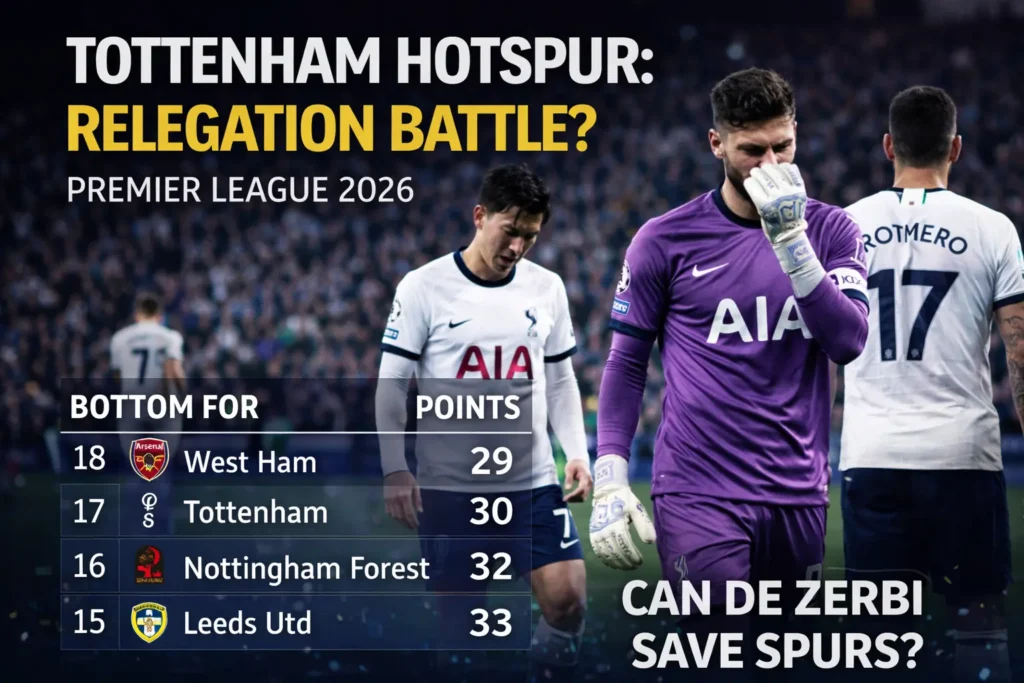
Say it slowly. Tottenham Hotspur. Relegation battle. Premier League. 2026.
Even typing those words feels surreal. For a club of Spurs’ stature — backed by one of the most expensive squads ever assembled by a side in the bottom half of the table — the idea that they could be playing Championship football next season has shifted from unthinkable to genuinely possible in the space of just a few months. Seven games remain. Time is running out fast.
How Did It Come to This?
That’s the question every Spurs supporter is asking, and the honest answer is that the collapse has been gradual, then sudden, then catastrophic. It started with injuries — the kind that pile up when a squad is pushed to its limits — and snowballed from there. Results dried up, confidence disappeared, and two managers came and went before the season had even reached its business end.
Tottenham are now on their third head coach of the campaign after dismissing Igor Tudor following a 3-0 home defeat to fellow relegation battlers Nottingham Forest. The loss was met with audible boos from Spurs’ own fans, and it proved to be Tudor’s final game in charge. Roberto De Zerbi — the man who built a glowing reputation on his progressive, attacking football at Brighton — has taken over. He inherits a dressing room that’s been through the wringer, with seven matches left and no margin for error whatsoever.
West Ham have had two managers this season. Forest are on their fourth. Leeds have stuck with Daniel Farke throughout. Yet Spurs — who came into the 2025/26 season with genuine European ambitions — are the ones staring down at the Championship. The irony is painful.
The Numbers Are Historically Bad
Let’s be blunt: Tottenham’s statistics this season don’t just look bad, they look historically bad.
They’re the only Premier League club yet to register a single win in 2026. Their current run of 13 league games without a victory (five draws, eight defeats) equals only the second-longest winless stretch in the club’s history, behind a particularly grim run from the 1934-35 season. After 31 games, they sit on just 30 points — a tally matching their joint-lowest return at this stage of a top-flight season since 1914-15.
At home it’s even grimmer. Spurs own the worst home record in the entire division, winning just two of 16 games at Tottenham Hotspur Stadium. Four consecutive defeats on their own turf — capped by that Forest humiliation — have stripped the ground of any intimidating atmosphere. The fans are restless. The players look uncertain. The whole place feels deflated.
Defensively, only Wolves and Burnley — the two clubs most analysts believe are already gone — have conceded more goals. That’s not the kind of company a club of Tottenham’s size and resources expects to be in.
The Bottom Six — Who Actually Goes Down?
With Wolves (17 points) and Burnley (20 points) essentially resigned to their fate, the real drama is playing out in the tier above. One more club joins them in the Championship, and right now it looks like a four-team race packed into just four points:
- West Ham — 18th, 29 points
- Tottenham — 17th, 30 points
- Nottingham Forest — 16th, 32 points
- Leeds United — 15th, 33 points
There are still crunching head-to-heads to come. On April 18, four of the bottom-six sides face each other in a set of fixtures that could define the entire run-in. After that, it becomes a test of nerve, form and — let’s be honest — a bit of luck.
Goal difference could well decide things if teams finish level on points. Leeds currently hold a significant advantage over West Ham in that regard, which could prove crucial come the final whistle of the season. Every goal conceded in the closing weeks matters enormously — a fact that won’t be lost on any manager in this battle.
Funnily enough, bottom club Wolves have been in the best recent form of any struggling side. Their wins over Aston Villa and Liverpool in recent weeks show just how unpredictable this bottom half has been all year. It won’t save them — far too late for that — but it underlines the point that no result in this run-in can be taken for granted.
Can De Zerbi Make a Difference?
Roberto De Zerbi is a genuinely exciting football manager. His work at Brighton was eye-catching, his ideas are modern, and his squads typically play with real intensity and purpose. All of which sounds great — but none of it addresses the very specific problem he’s walking into.
Taking over a relegation-threatened club with seven games to go isn’t a job that rewards philosophical football. It rewards organisation, quick decision-making and the ability to get a group of players who’ve had a miserable few months to dig in and grind results. Whether De Zerbi, whose teams are built on high-pressing, possession-based approaches, can adapt quickly enough is a legitimate question.
His squad isn’t without quality, either. Cristian Romero is a top-level defender on his day. Son Heung-min, when fit and motivated, can still do damage. There’s talent here. It’s just been buried under a season of chaos and inconsistency. De Zerbi’s task is to find it again — fast.
Romero himself set the tone after the Forest defeat, describing the remaining fixtures as “seven finals.” That’s the mindset. Whether the team can match the rhetoric with performances on the pitch is what everyone wants to see.
The Run-In — Game by Game
Sunderland away on April 12 is De Zerbi’s first test — a tricky opening, with the Stadium of Light bouncing after a recent Tyne-Wear derby win. From there, Spurs have home games against Brighton and Wolves away on April 25, before a crucial home clash with Leeds on May 9. Those last two fixtures feel enormous. Win them both and Spurs have a genuine chance of pulling clear. Lose either and they’re in deep, deep trouble.
One saving grace is that Forest’s remaining schedule looks significantly harder, with fixtures against Aston Villa, Chelsea, Newcastle and Manchester United still to come. West Ham’s run-in is softer, but they’ve shown they can’t be relied upon for consistency this season. Spurs, on paper, have a route out of this.
The problem is that “on paper” has meant very little to this Tottenham side all year.
The Bigger Picture
Even if Spurs survive — and they might, just — the damage has already been done to the club’s reputation and long-term trajectory. A season that began with ambition has become a story of dysfunction, managerial upheaval and historically poor form. The questions about how a squad this expensive ended up in this position won’t disappear in the summer. They’ll only get louder.
For now, though, none of that matters. Seven games. One objective. Stay in the Premier League.
De Zerbi has performed genuine miracles with clubs before. He’ll need to call on every bit of that experience to do it again — and faster than he ever has.