
Sky Bet League Two 2025-26: News, Fixtures, Table and Promotion Race
The Sky Bet League Two is the fourth tier of English football and the lowest fully professional division in the EFL. The 2025-26 campaign — the 22nd season under the current League Two format — has produced one of the most statistically rich seasons in recent memory.
Twenty-four clubs are competing across a 46-match season that began on 2 August 2025 and concludes on 25 May 2026. With Aaron Drinan leading the scoring charts on 18 goals and Bromley recording a 16-match unbeaten run — the longest of the campaign — there has been no shortage of storylines at both ends of the table.
At Today’s Sports News, League Two coverage sits alongside our reporting on the National League, League One, and the Premier League. This hub brings together the latest match reports, tactical analysis, table movements, and transfer updates across the division.
Latest posts
League Two
View all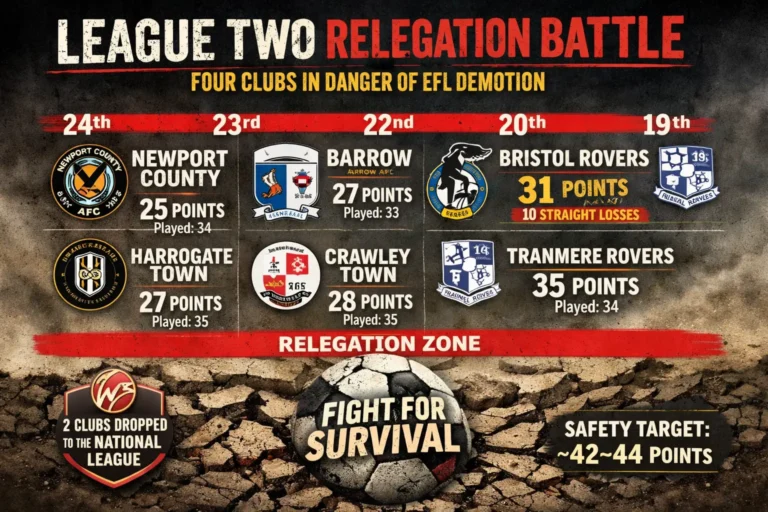
League Two Relegation Battle 2025-26: Four Clubs in the Drop Zone With Eight Weeks to Go
A 20-game winless run for Harrogate, a 10-match losing streak for Bristol Rovers, and Newport County rooted to the bottom on 25…
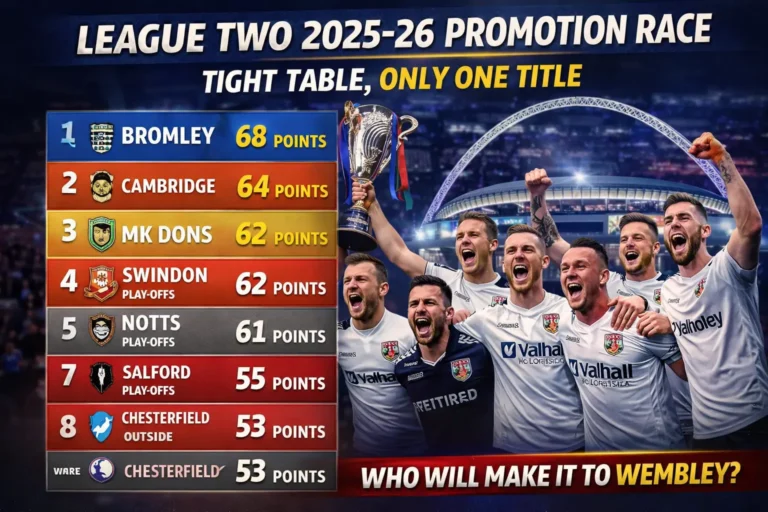
League Two Promotion Race 2025-26: Who Goes Up, Who Misses Out?
Bromley are closing in on an extraordinary first League Two title. But with three automatic places and four play-off spots still…

League Two 2026: A Season of Surprises and New Talent
As we dive into 2026, League Two in the UK is full of thrilling moments and exciting potential. From unexpected match results…
The 2025-26 League Two Season So Far
The promotion race in 2025-26 has been tightly contested from early in the campaign. Unlike some seasons where one or two clubs pull clear at the top, the automatic places have remained genuinely open, with several clubs separated by slim margins as the final weeks approach.
Bromley have been the season’s standout story beyond the top of the table. A 16-game unbeaten run — the longest in the division this season — transformed their campaign and illustrated the unpredictable nature of League Two, where momentum can shift an entire season in a matter of weeks.
At the top of the goalscoring charts, Aaron Drinan has set the benchmark for the division with 18 goals. At this level, a reliable, consistent scorer can be the single most important factor in a promotion challenge — and Drinan’s form has reflected that.
The relegation picture has been equally compelling. With only two clubs dropping to the National League, the margin between survival and the drop is razor-thin for several sides near the foot of the table. Harrogate Town’s 20-match winless run — the worst in the division this season — stands as a cautionary example of how quickly a League Two campaign can unravel.
How Promotion from League Two Works
Promotion from League Two operates on a straightforward but fiercely competitive structure.
- Automatic promotion: The top three clubs in the final table earn direct promotion to EFL League One for the following season.
- Play-offs: Clubs finishing 4th through 7th compete in two-legged semi-finals, with the winners meeting in a single final at Wembley. The play-off winner takes the fourth and final promotion place.
- Relegation: The bottom two clubs in the table are relegated to the National League – returning to non-league football and losing EFL status.
The play-off structure rewards different qualities from the regular season. Form over 46 games builds the foundation, but knockout football at Wembley demands tactical discipline, squad depth, and the ability to perform under intense pressure on a single occasion.
Clubs to Follow in 2025-26
The 2025-26 League Two field includes clubs with contrasting ambitions, histories, and supporter bases.
- Notts County — the world’s oldest professional football club, playing at Meadow Lane (capacity 19,841), have one of the division’s largest fanbases and recorded the season’s highest single-game attendance of 12,487 against Grimsby Town in February 2026.
- Grimsby Town — recorded the season’s biggest home win (7-1 against Cheltenham) and have been consistent challengers throughout the campaign.
- Milton Keynes Dons — produced the season’s biggest away win on two occasions (4-0), demonstrating the attacking output needed to sustain a promotion challenge on the road.
- Bromley — their 16-game unbeaten run made them the division’s most talked-about mid-season story and reshaped perceptions of what a newly-promoted side can achieve.
- Swindon Town and Bristol Rovers — two clubs with strong historical pedigree aiming to re-establish themselves in League One.
Fixtures, Scheduling, and the Physical Demands of League Two
A 46-match season places considerable physical and logistical demands on League Two squads. Unlike the Championship or League One, where clubs tend to be geographically clustered into broadcast windows, League Two fixtures involve national travel across England — including long midweek trips that compress recovery time between games.
Squad depth is therefore a decisive factor. Clubs with 18 to 20 players capable of contributing at this level tend to sustain challenges across the full season, while those relying on a core of 13 or 14 regulars often find their form deteriorating in the final months.
Weather and postponements are a further variable. Pitch quality varies significantly between the 24 League Two grounds, and winter weather disruptions can create fixture backlogs that disproportionately affect clubs with lower budgets for squad rotation.
Tactical Trends in the 2025-26 Season
League Two has continued to evolve tactically in 2025-26. The perception of the division as purely physical and direct is increasingly outdated, with several clubs now operating structured possession-based systems more commonly associated with the Championship.
- Set-piece efficiency remains one of the most important factors in the division. Goals from corners, free-kicks, and throw-ins account for a disproportionately high percentage of League Two goals — clubs that invest time in dead-ball routines gain a measurable edge.
- Compact defensive structures — holding a low block and absorbing pressure before hitting on the counter — remain a valid strategy for sides with limited attacking resources.
- Pressing-oriented football has become more common at the top of the division, with managers using high lines and aggressive pressing triggers to win the ball in advanced positions.
The best managers in the division adapt their systems to the opposition rather than relying on a single approach across 46 games — a flexibility that tends to separate the promotion contenders from the mid-table sides.
Recruitment and Squad Construction in League Two
Budget constraints make recruitment strategy one of the most consequential decisions for League Two clubs. The gap between the best-resourced and most modestly-funded sides is significant, but it is not always decisive — some of the strongest squads are assembled through intelligent use of limited resources.
Common approaches in 2025-26 include short-term contracts that limit financial exposure, loan agreements with Championship and League One clubs, and targeting players released from higher divisions who are motivated to prove themselves at League Two level. The January window remains an important opportunity to reshape squads — both for promotion-chasing sides looking to add quality and for relegation-threatened clubs seeking experienced cover.
The League Two Play-Offs — Why They Matter
The League Two play-offs are one of the most dramatic annual events in English football. A single match at Wembley — following two-legged semi-finals — determines the fourth and final promotion place, and the stakes could not be higher.
For clubs that finish 4th through 7th in the table, the play-offs represent an opportunity to achieve through three matches what 46 league games have not. Conversely, finishing in a play-off position after a strong season and losing at the final hurdle is one of the most devastating outcomes in the football calendar.
The Wembley final also carries significant commercial importance. For League Two clubs, promotion to League One can mean additional revenue, improved sponsorship opportunities, and greater access to talent — a step-change that can define the trajectory of a club for years.
League Two as a Development Pathway
Beyond the promotion race, League Two plays a structural role in English football development. Players regularly use the division as a proving ground before attracting interest from League One and Championship clubs. At 18 goals for the season, Aaron Drinan’s output exemplifies the kind of form that attracts attention from higher tiers.
Managers, too, have used League Two as a launching pad. Several of the current generation of Championship coaches established their reputations in the fourth tier, with the pressure and pace of a 46-game professional season serving as an effective development environment.
FAQ Section — Full Replacement
Q1: What is League Two in English football?
League Two is the fourth tier of the English Football League (EFL) and the lowest fully professional division in the English pyramid. It sits below League One and above the National League, and is officially known as Sky Bet League Two for sponsorship purposes. Twenty-four clubs compete across a 46-match season.
Q2: Who is top of League Two in 2025-26?
[Update this answer weekly with the current table leader and their points total. Example: “As of [date], [Club] lead the Sky Bet League Two table with [X] points from [Y] games.”]
Q3: Who is the top scorer in League Two 2025-26?
Aaron Drinan leads the League Two scoring charts in 2025-26 with 18 goals. [Update as the season progresses.]
Q4: How does promotion from League Two work?
The top three clubs in the League Two table earn automatic promotion to EFL League One. The clubs finishing 4th through 7th then compete in play-offs — two-legged semi-finals followed by a single final at Wembley — with the winner also promoted. The play-off final is the highest-attended single-club match in world football by neutral attendance.
Q5: How many teams get relegated from League Two?
Two clubs are relegated from League Two at the end of each season, dropping into the National League and losing their EFL status. Relegation from the EFL carries significant financial consequences that can affect a club’s structure for several seasons.
Q6: When does the 2025-26 League Two season end?
The 2025-26 Sky Bet League Two regular season ends on 25 May 2026. The play-off final takes place in late May 2026 at Wembley Stadium.
Q7: Are League Two clubs fully professional?
Yes — League Two is a fully professional division and all 24 clubs operate under EFL rules. However, budgets vary considerably, from clubs with relatively strong financial backing to sides operating on tightly managed resources where recruitment efficiency is critical.
Q8: What is the difference between League Two and the National League?
League Two is part of the EFL (English Football League), while the National League — officially the Enterprise National League in 2025-26 — is the highest tier of non-league football and sits one division below League Two. The bottom two clubs in League Two are relegated to the National League each season, and the National League champions (plus play-off winners) are promoted to League Two.
Q9: Which League Two clubs have previously played in the Premier League?
Several current League Two clubs have played in the Premier League at various points in their history. Swindon Town and Oldham Athletic are among the clubs with top-flight experience who are competing in the fourth tier in 2025-26.
Q10: How many League Two play-off spots are there?
Four clubs qualify for the League Two play-offs each season, finishing in positions 4th through 7th in the final table. Two two-legged semi-finals determine the finalists, and the single Wembley final produces the fourth and final promotion place to League One.