

NATIONAL LEAGUE FOOTBALL NEWS, FIXTURES AND PROMOTION RACE
The Enterprise National League is the highest tier of non-league football in England and the most demanding step on the path back into the EFL. The 2025-26 season — the first under Enterprise Rent-A-Car’s sponsorship after Vanarama’s long-running deal ended — has produced one of the most dominant title races in the division’s recent history.
Twenty-four clubs are competing across a 46-match campaign, from promoted sides out of the National League North and South through to relegated EFL League Two clubs rebuilding their ambitions. With York City establishing a commanding lead at the top, attention has shifted to the play-off places — and to which clubs will fall into the regional divisions below.
At Today’s Sports News, National League coverage is treated as a core part of the football news landscape rather than a footnote. This hub brings together the latest match reports, tactical analysis, table movements, and transfer updates throughout the season.
Latest posts
National League
View all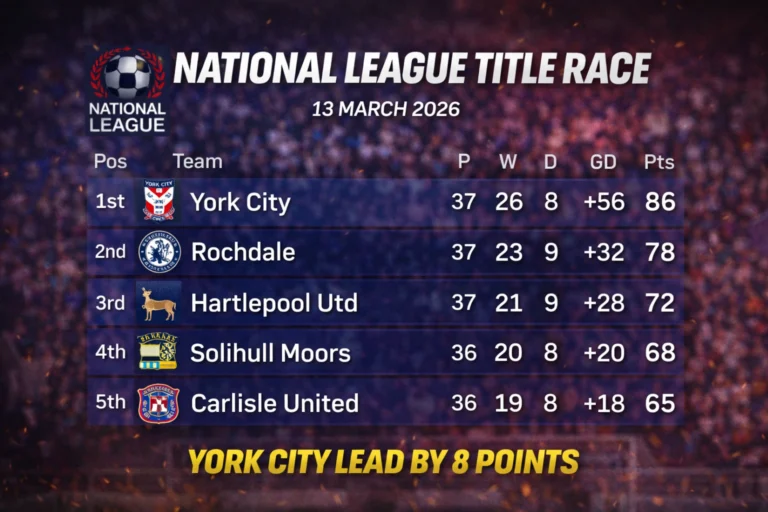
York City’s Run-In: Seven Games to Seal One of Non-League Football’s Most Dominant Seasons
With 86 points banked, an 8-point lead at the top, and seven matches remaining, York City are on the cusp of a…

Stuart Maynard: The Man Behind York City’s Most Exciting Season in Years
He arrived at the LNER Community Stadium in late August 2025 with something to prove after a difficult spell at Notts County.…

Ollie Pearce: York City’s 29-Goal Machine Firing the Minstermen Towards the Football League
Signed from non-league football’s South Coast conveyor belt. Ollie Pearce has become one of the most lethal strikers at the National League…
Understanding the Role of the National League in English Football
The National League occupies a unique position within the English football pyramid. It is the highest level of non-league football, yet operates in many ways like a fully professional division. Clubs face long seasons, national travel, and intense pressure created by the limited promotion places available.
Unlike the Premier League, where financial disparity often shapes outcomes, success in the National League depends more heavily on structure, squad balance, and consistency. Margins are fine, and the difference between promotion contenders and mid-table sides is often minimal.
This competitive balance is one of the reasons National League football news attracts sustained attention throughout the season.
The 2025-26 National League Season So Far
The headline story of the 2025-26 campaign has been York City’s remarkable consistency under Stuart Maynard. With 86 points banked heading into the final weeks and an eight-point gap over the chasing pack, the Minstermen are on course for automatic promotion and one of the most impressive single-season records the division has seen.
The play-off battle remains genuinely open. The six clubs competing for the five remaining spots are separated by margins that can shift with a single midweek result. This congestion in the middle of the table is typical of how National League seasons develop — early-season form often flatters or misleads, and the real picture only emerges once teams have played each other twice.
At the bottom, the relegation battle has also intensified. Four clubs will drop into the National League North or South at the end of the season, and several sides are separated by just a handful of points. Survival often demands a change in approach — prioritising defensive organisation and home points over ambitious attacking play.
National League Fixtures and Scheduling Challenges
National League fixtures present challenges unseen in higher divisions. Travel distances, midweek scheduling, and limited recovery time place physical and logistical strain on squads.
Fixture congestion often leads to:
Increased squad rotation
Greater reliance on academy loans
Tactical conservatism away from home
Monitoring National League fixtures becomes crucial when analysing form, especially during winter months when conditions can dramatically influence match outcomes.
Reading the National League Table Properly
The National League table provides a snapshot, but it rarely tells the full story. Points totals alone do not capture trends such as momentum shifts, fixture difficulty, or performance sustainability.
Analysts often look beyond league position to consider:
Goal difference against top-half opposition
Home and away performance balance
Results in high-pressure six-pointer matches
Teams maintaining steady accumulation rather than short winning streaks often emerge as the most reliable promotion candidates.
The Promotion Race: Why It Is So Ruthless
Promotion from the National League is widely regarded as one of the hardest achievements in English football. With only one automatic promotion place available, even the strongest teams face uncertainty.
The play-off system introduces additional complexity, often rewarding:
Tactical discipline
Mental resilience
Experience in knockout scenarios
Unlike higher divisions such as the Premier League, where title races are shaped over months (internal link opportunity), National League promotion can hinge on single moments.
Tactical Trends Across the National League
Contrary to outdated perceptions, National League football is tactically diverse. While physicality remains important, many teams now prioritise structured build-up and controlled transitions.
Common tactical themes include:
Compact defensive blocks to limit space
Emphasis on set-piece efficiency
Flexible formations adapting to opposition
Managers who adjust systems rather than personnel often achieve better long-term results.
Key Player Profiles That Shape Campaigns
Individual influence remains pronounced at National League level. A single consistent performer can dramatically alter a team’s trajectory.
Influential roles often include:
Proven goal scorers thriving on limited chances
Centre-backs organising defensive lines
Midfielders controlling tempo under pressure
These players frequently attract attention from EFL clubs, reinforcing the league’s role as a developmental pathway.
Transfers, Loans and Squad Construction
Recruitment strategy in the National League demands precision. Budgets vary widely, making intelligent squad building essential.
Successful clubs often focus on:
Short-term contracts to manage financial risk
Loan agreements with EFL sides
Players with proven league experience
January transfer windows can significantly reshape promotion races or relegation battles.
Relegation Battles and Survival Strategy
At the opposite end of the table, survival becomes the overriding objective. Relegation from the National League carries financial and structural consequences that can linger for years.
Teams fighting to stay up frequently prioritise:
Defensive organisation
Minimising losses over chasing wins
Maximising points from home fixtures
Survival often depends on managing pressure rather than chasing dramatic turnarounds.
Supporter Culture and Matchday Influence
Fan engagement plays a critical role in National League football. Smaller grounds and close community ties often generate intense atmospheres that influence results.
Home advantage is strengthened by:
Familiar playing surfaces
Vocal local support
Reduced travel fatigue
Clubs that harness supporter momentum often outperform expectations across a season.
Media Coverage and Growing Interest
National League football coverage has expanded as streaming access and digital reporting improve. Supporters now follow fixtures, tables, and results more closely than ever.
At Today’s Sports News, National League reporting sits alongside coverage of top-tier competitions such as the Premier League and broader football news , reinforcing the league’s importance within the national game.
The National League as a Pathway to the EFL
Beyond promotion battles, the National League plays a vital role in English football development. Players, coaches, and executives often use the league as a proving ground before progressing higher.
Its contribution includes:
Providing opportunities for late developers
Testing managerial adaptability
Maintaining competitive balance across tiers
Success here often signals readiness for greater challenges.
Frequently Asked Questions – National League Football
How many teams compete in the National League?
The National League consists of 24 teams competing across a 46-match season.
How does promotion from the National League work?
One team gains automatic promotion, while additional promotion places are decided via play-offs.
Is the National League fully professional?
Many clubs operate full-time squads, though financial models differ.
How many teams are relegated from the National League?
Typically, four teams are relegated to regional divisions each season.
Why is promotion from the National League considered difficult?
Limited promotion places and a demanding play-off structure create high-pressure environments.