
How Does VAR Work in Football?
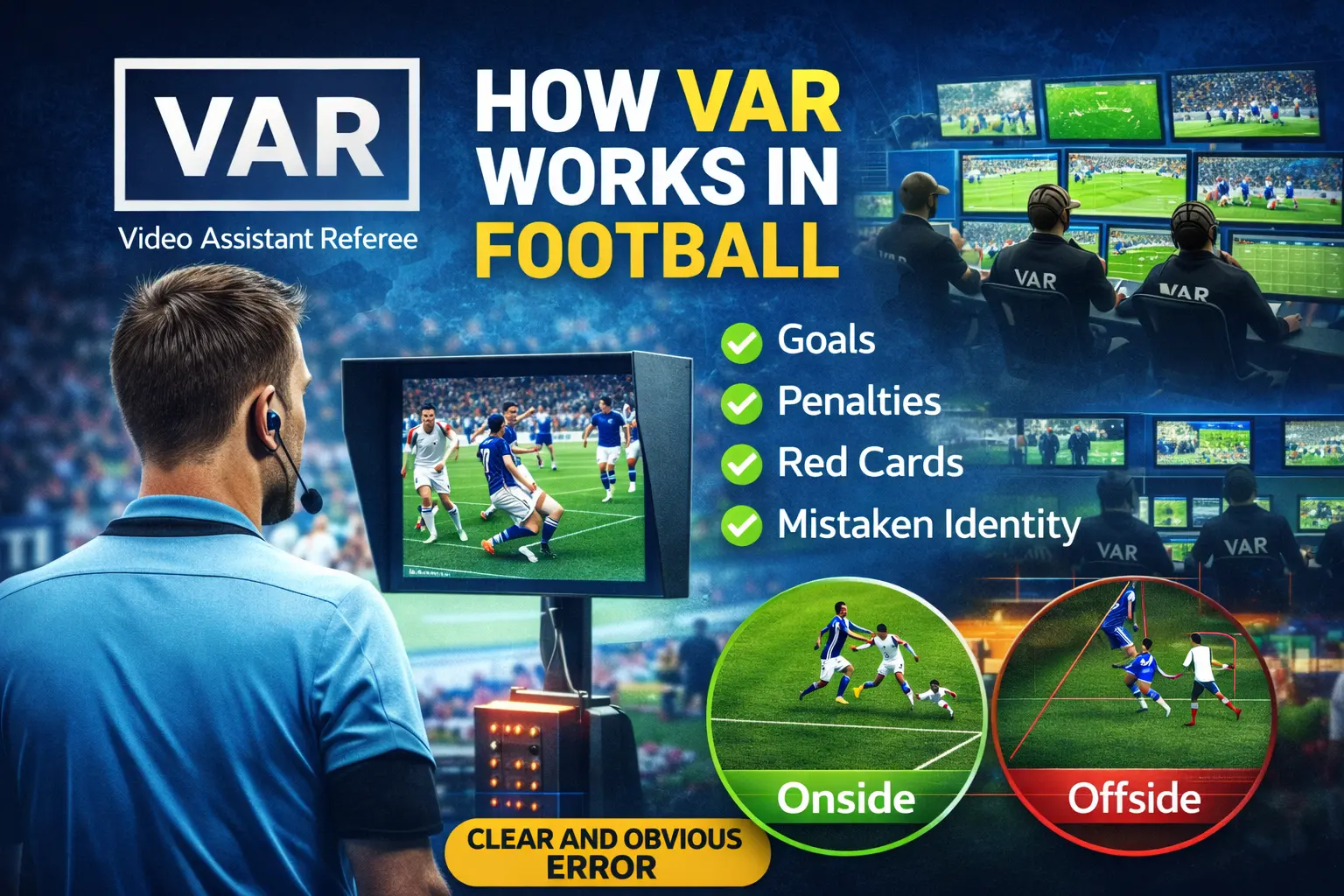
VAR (Video Assistant Referee) is used in football to review key decisions and correct clear and obvious errors made by the on-field referee.
It supports referees by using video footage to ensure major match-changing decisions are as accurate as possible.
VAR is only used for four types of decisions and does not re-referee the entire match.
What Is VAR in Football?
Video Assistant Referee (VAR) is a “safety net” for the referee on the pitch. Even though football is fast-paced, VAR ensures that massive, game-changing mistakes are caught and corrected.
Here is a breakdown of how it actually works in practice:
1. The “Extra Eyes” (The Team)
VAR isn’t just one person; it’s a team (usually a lead official, an assistant, and a replay operator) sitting in a room filled with monitors. They have access to every camera angle in the stadium—angles the referee on the field might have missed because players were in the way.
2. The Remote Hub (The Location)
The VAR team isn’t usually at the stadium. They are typically based in a Video Operations Room (VOR), which is a centralized hub (like a high-tech TV studio) that handles multiple games at once. They communicate with the referee via a earpiece.
3. When Do They Step In?
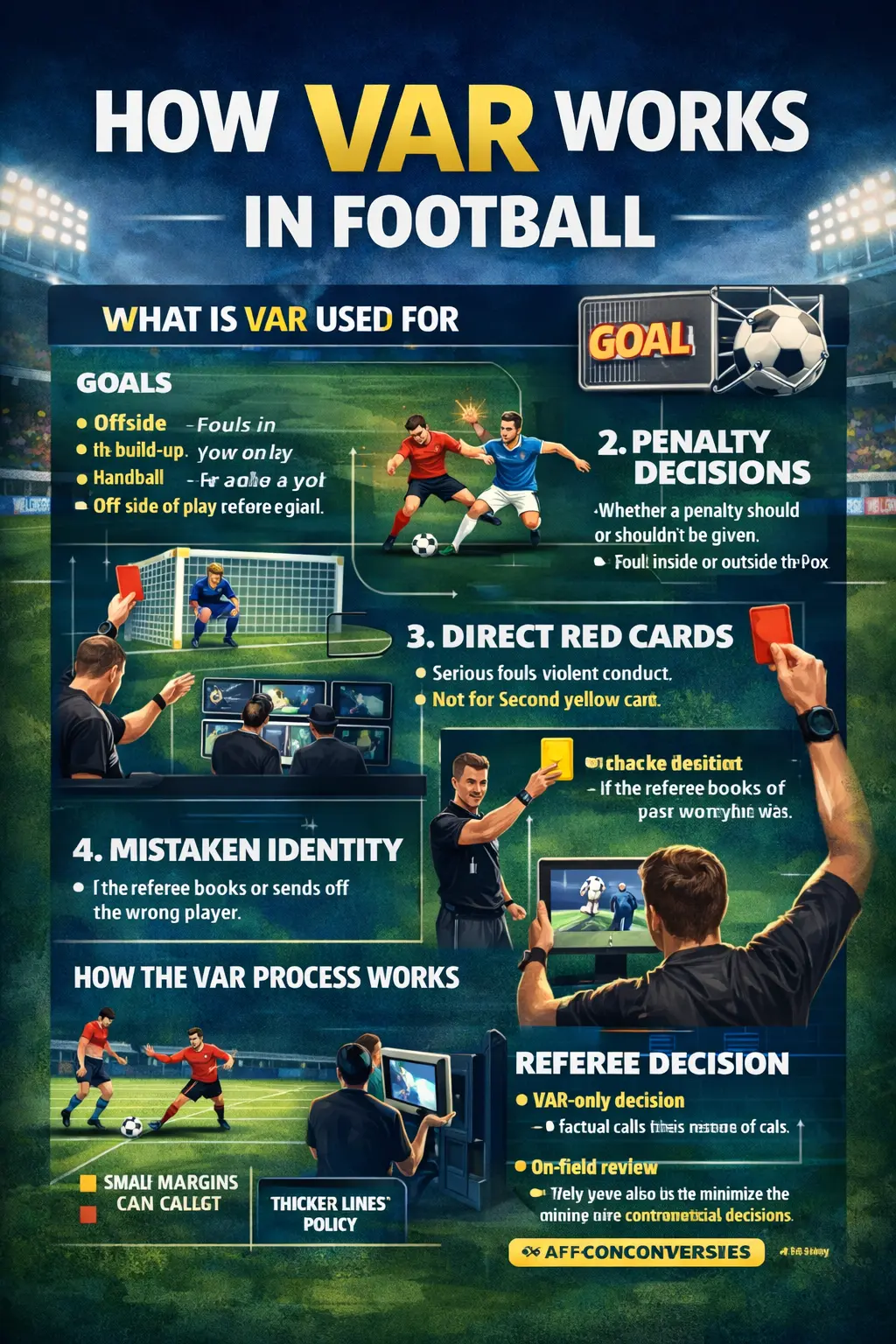
The VAR doesn’t interfere with every minor foul or throw-in. They only get involved for “Clear and Obvious Errors” or “Serious Missed Incidents” in four specific categories:
- Goals: Was there an offside or a foul in the build-up?
- Penalties: Was the foul inside the box? Was it actually a foul?
- Direct Red Cards: Did the referee miss a dangerous tackle or a punch?
- Mistaken Identity: Did the ref give a yellow card to the wrong player?
4. Who Is the Boss?
This is the most important part: The VAR is an assistant, not the judge.
- The VAR can suggest that the referee take another look at the “Pitchside Monitor.”
- The referee can choose to ignore the VAR or change their mind after watching the replay.
- The final word always belongs to the referee on the grass.
Why Was VAR Introduced in Football?
VAR was introduced to:
- Reduce serious refereeing errors
- Improve fairness in crucial decisions
- Use technology to support officials
Before VAR, incorrect decisions could not be changed once play restarted. VAR allows officials to review incidents that can directly affect the outcome of a match.
What Decisions Can VAR Review?
Think of these four categories as the “Big Four.” To prevent the game from stopping every two minutes, FIFA and IFAB strictly limit VAR to incidents that can completely change the outcome of a match.
Here is a deeper look at what actually happens within those four categories:
1. Goals and Build-up Offenses
VAR checks everything that happened leading up to the ball crossing the line. If a goal is scored, the “silent check” looks for:
Offsides: Even by a few millimeters.
Fouls: If the attacking team committed a foul to win the ball back.
Out of Play: If the ball went out of bounds earlier in the move.
Handballs: Any accidental or intentional handball by the scorer.
2. Penalty Decisions
This is often the most controversial area. VAR intervenes to ensure the referee didn’t make a “clear and obvious error” regarding:
The Foul: Was there actually contact, or did the player dive?
Location: Was the foul committed inside or outside the penalty area?
Infringements: Did the goalkeeper move off their line too early during the kick?
3. Direct Red Cards
VAR acts as a watchdog for violent conduct or dangerous play that the referee might have missed in the heat of the moment.
Note: VAR cannot review second yellow cards, even if they lead to a sending-off. It only checks for straight red cards (like a high-speed lunging tackle or off-the-ball striking).
4. Mistaken Identity
While rare, referees sometimes lose track of who committed a foul in a crowded penalty box.
If the referee gives a Yellow or Red card to Player A, but Player B actually committed the foul, VAR will step in to make sure the right person is disciplined.
The “Everything Else” Rule: If a referee misses a regular foul in the middle of the pitch, awards a corner kick that should have been a goal kick, or gives a “soft” yellow card, VAR is legally forbidden from intervening. The game simply carries on.
Category What VAR CAN Review What VAR CANNOT Review Goals Offsides, fouls in the build-up, and if the ball went out of play. Regular fouls that happen far away from a goal-scoring move. Penalties If a penalty was wrongly awarded or if a clear foul was missed. “Soft” contact that isn’t a “clear and obvious” error. Red Cards Direct Red Cards and now Incorrect Second Yellow Cards. First yellow cards or “missed” second yellow cards. Mistaken Identity If the referee cards the wrong player (Yellow or Red). Arguments between players that don’t result in a card. Restarts Incorrectly awarded corner kicks (if the check is instant). Throw-ins, goal kicks, or free-kicks in the middle of the pitch.
How Does VAR Work Step by Step?
Here is how VAR works during a football match:
- An incident occurs
- VAR automatically checks the footage
- VAR communicates with the referee
- The referee either accepts advice or reviews the incident
- A final decision is made
This process usually takes seconds, but can take longer for complex incidents.
What Is a VAR Check?
A VAR check is the initial review of an incident.
- It happens silently in the background
- Play often continues
- Fans may not notice it
If no error is found, the check ends and play continues.
What Is a VAR Review?
A VAR review happens when:
- VAR believes a clear error may have occurred
- The referee is advised to review the footage
The referee may:
- Change the decision
- Stick with the original call
What Is the Referee Review Area?
The Referee Review Area (RRA) is the pitch-side monitor.
When the referee goes to the screen:
- The decision becomes theirs alone
- VAR only provides footage
- The referee is not instructed what to decide
This reinforces the referee’s authority.
What Does “Clear and Obvious Error” Mean?
This is the “Golden Rule” of VAR. It was created to prevent the Video Assistant from “re-refereeing” the game or looking for tiny, debatable mistakes. If a decision is 50/50, the official on the pitch stays in charge.
To be considered “Clear and Obvious,” an error must meet these three strict criteria:
1. The “Almost Everyone Agrees” Test
If you show the replay to ten neutral fans and all ten say, “Wow, the ref got that wrong,” it is likely a clear and obvious error.
Example: A striker trips over their own feet, but the referee gives a penalty. The video shows no contact at all. This is a “clear” mistake.
2. Objective vs. Subjective
VAR loves objective facts because they aren’t open to opinion.
Objective (VAR Intervenes): The ball was out of play, or a player was offside by an inch. These are “black and white” facts.
Subjective (VAR Stays Away): How “hard” was a tackle? Was a push “strong enough” to be a foul? Because these are matters of opinion, the VAR will usually defer to the on-field referee’s “on-the-spot” judgment.
3. The “High Bar” for Evidence
The VAR isn’t allowed to guess. They must have a camera angle that proves the referee was wrong.
If the footage is blurry, blocked by other players, or inconclusive, the VAR will tell the referee: “Check complete—stick with your original decision.” —
If the decision is… Does VAR intervene? Why? A Howler (Huge mistake) YES To protect the integrity of the result. A “Grey Area” (Debatable) NO To keep the game moving and respect the ref’s authority. A Tiny Detail (Not “Big 4”) NO It doesn’t fall under the VAR protocol.
How Does VAR Work for Goals?
When a goal is scored, VAR checks:
- Offside in the build-up
- Fouls in the build-up
- Handball offences
- Whether the ball went out of play
If an offence is found, the goal is disallowed.
How Does VAR Work for Offside?
Offside decisions are reviewed using:
- Freeze-frame technology
- Calibrated lines
- Multiple camera angles
Why Are Offside Decisions So Tight?
Offside laws are based on:
- Any playable body part
- Exact positioning at the moment the ball is played
Even marginal offsides can lead to goals being ruled out.
How Does VAR Work for Penalties?
VAR reviews penalties to determine:
- Whether a foul occurred
- Whether contact was inside the box
- Whether the decision was clearly wrong
VAR does not usually intervene for soft or debatable fouls.
How Does VAR Work for Red Cards?
VAR can only review direct red cards, not yellow cards.
VAR checks:
- Serious foul play
- Violent conduct
- Denial of a goal-scoring opportunity
Yellow card offences cannot be upgraded unless they qualify as a red card offence.
What Is Mistaken Identity in VAR?
Mistaken identity occurs when:
- The wrong player is punished
- A card is given to the wrong individual
VAR can correct this immediately.
Who Are the VAR Officials?
A VAR team usually includes:
- VAR (main video referee)
- Assistant VAR
- Replay operator
They are all qualified referees.
Where Is VAR Based?
In the Premier League:
- VAR is based at Stockley Park in London
Officials review matches remotely using multiple camera feeds.
Why Does VAR Take So Long?
VAR decisions can take time because:
- Multiple angles must be checked
- Lines must be drawn for offsides
- Officials must ensure accuracy
Accuracy is prioritised over speed.
Why Is VAR So Controversial?
VAR is controversial because:
- Marginal offsides feel harsh
- Delays disrupt the flow
- Fans struggle with transparency
Despite this, VAR has improved decision accuracy overall.
Is VAR Used in All Competitions?
No.
VAR is used in:
- Premier League
- Champions League
- FA Cup (later rounds)
VAR is not used in:
- Lower leagues
- Many grassroots competitions
Does VAR Change the Laws of the Game?
It is a common misconception that VAR “invented” new rules. In reality, VAR is just a high-tech magnifying glass. It uses the same rulebook that has existed for decades, but it applies those rules with a level of precision that the human eye simply cannot achieve in real-time.
Here is how VAR interacts with the existing laws without actually changing them:
1. The “Precision” Problem (Offside)
The Offside Law hasn’t changed: a player is offside if any part of their head, body, or feet is nearer to the opponents’ goal line than both the ball and the second-last opponent.
Before VAR: Referees gave the “benefit of the doubt” to the attacker because they couldn’t see tiny gaps.
With VAR: We now use Crosshair Technology to measure gaps of a single centimeter. The law is the same, but the “margin of error” has disappeared.
2. The “Slow Motion” Trap (Fouls & Handballs)
The definition of a “careless” or “reckless” foul remains the same in the rulebook. However, video evidence changes how we perceive those fouls:
Point of Contact: In full speed, a tackle might look fine. In super slow-motion, you can see the studs hitting an ankle.
Intent vs. Result: The law focuses on the action. VAR allows the referee to see the exact point of impact, which often makes fouls look more severe than they did live.
3. The “Subjective” Barrier
Even with 20 cameras, the laws of football are full of “opinion-based” words like natural position, deliberate, and excessive force.
Because VAR doesn’t change the laws, two different VAR officials might look at the same video and have two different opinions on a “Handball.”
This is why fans get frustrated—they expect the video to provide a “Yes/No” answer, but the Law of the Game still requires a human to make a judgment call.
Comparison: Human Eye vs. VAR Evidence
| The Law | Human Eye (Live) | VAR Evidence (Video) |
| Offside | “Looks level to me!” | “The shoulder is 2cm offside.” |
| Handball | “Did it hit his hand?” | “It hit the ‘T-shirt zone’ of the arm.” |
| Red Card | “That looked like a hard tackle.” | “His studs were showing and caught the shin.” |
What Is Semi-Automated Offside?
Semi-automated offside uses:
- Player tracking technology
- Automated line drawing
- Faster decision-making
It is currently used in select competitions.
Can VAR Decisions Be Overturned?
Yes.
The referee can:
- Overturn the original decision
- Stick with the original decision
VAR cannot force a change.
Does VAR Make Football Fairer?
The question of “fairness” is where the cold, hard data of VAR meets the heated emotions of football fans. While the statistics prove the game is more “correct,” whether it feels “fairer” is a different story.
1. The Statistical Truth (Accuracy)
Data from major leagues like the Premier League and competitions like the World Cup show a massive jump in accuracy.
Pre-VAR: On-field referees were getting about 82% of “game-changing” decisions correct.
With VAR: That number has climbed to over 96%.
In 2026, with Semi-Automated Offside Technology (SAOT), the “human error” of drawing offside lines has been virtually eliminated, making that specific rule 100% consistent.
2. The Death of the “Howler”
VAR has almost entirely removed the “Major Error”—the kind of mistake that haunts a referee’s career.
Handballs: Think of Diego Maradona’s “Hand of God.” With VAR, that goal is disallowed in seconds.
Ghost Goals: Instances where the ball clearly crosses the line but the ref misses it are now caught by Goal-Line Technology working alongside VAR.
3. The “Subjectivity” Trap
Even with 4K replays, football rules are not always black and white. This is where the “fairness” debate lives.
The “T-Shirt Line” for Handballs: The law says a handball is only a foul if it hits below the bottom of the armpit (the “T-shirt line”). But if a ball deflections off a player’s thigh onto their arm, is that “natural”? Two different VARs might give two different answers.
Consistency: Fans often feel it is unfair when a foul is given as a penalty in one match, but an almost identical foul in a different match is ignored by a different VAR team.
[Image diagram showing the handball T-shirt line rule on a player’s arm]
4. The “Spirit of the Game” Argument
Many argue that “fairness” isn’t just about the final score, but about the experience.
Micro-Offsides: Is it “fair” to disallow a beautiful team goal because a striker’s toenail was 2mm offside? Technically, it’s the correct decision, but many feel it goes against the “spirit” of attacking football.
The “Big Club” Bias: There is a common (though unproven) perception that VAR is more likely to help bigger teams because the pressure on the referee is higher.
Common VAR Myths
VAR makes all decisions perfect
False. VAR reduces errors but does not eliminate them.
VAR referees matches
False. The referee remains in control.
VAR checks everything
False. Only four categories are reviewed.
Why Do Fans Hate VAR?
Fans dislike VAR because:
- Celebrations are delayed
- Decisions feel clinical
- Explanations are limited
Improved communication has helped, but frustration remains.
How Does VAR Communicate Decisions?
Communication methods include:
- On-screen graphics
- Stadium announcements (in some competitions)
- Referee signals
Transparency varies by league.
VAR in the Premier League
Premier League VAR has:
- Specific interpretation guidelines
- Dedicated officials
- Ongoing reviews and adjustments
Rules are refined each season.
Does VAR Affect Match Flow?
The biggest debate in football isn’t usually about the rules, but about the clock. While VAR was designed to bring “maximum benefit with minimum interference,” it has undeniably changed the rhythm of the 90-minute game.
Here is a closer look at how VAR impacts the flow of a match:
1. The “Waiting Room” Effect (Slowing the Match)
The most visible change is the delay. When a goal is scored, players and fans can no longer celebrate instantly. There is often a 60 to 90-second “silent check” where everyone stands around waiting for a thumbs-up from the VAR hub. If the referee has to go to the Pitchside Monitor (the “Referee Review Area”), that delay can stretch to 3 or 4 minutes.
2. Massive Stoppage Time
Because the watch doesn’t stop during these reviews, we are seeing record-breaking amounts of added time. It is now common to see:
8–12 minutes of stoppage time at the end of a half.
Matches effectively lasting 100+ minutes in total.
This tests the physical endurance of players, leading to more late-game goals (and late-game injuries).
3. Momentum Shifts
Football is a game of “energy.” A team that is dominating might lose all their steam if a 5-minute VAR review kills the atmosphere. Conversely, a team under heavy pressure can use a VAR break to catch their breath, regroup, and talk to their coach—essentially acting like an unplanned Time Out.
4. The “Emotional Rollercoaster”
The flow of the fans’ experience has changed the most.
The “Ghost” Goal: You celebrate a last-minute winner, only for it to be ruled out three minutes later for a tiny offside.
The Delayed Penalty: A team might be counter-attacking on one end of the field, only for the ref to stop play and go back to the other end to award a penalty for something that happened two minutes prior.
Quick Summary
- VAR stands for Video Assistant Referee
- It reviews goals, penalties, red cards, and mistaken identity
- The referee makes the final decision
- VAR is used to correct clear and obvious errors